Hiring salespeople is rarely simple.
A candidate may look strong on paper, interview well, and have experience that seems valuable. But then, during the hiring process, you uncover a gap.
Maybe they have strong industry knowledge but little experience in new business prospecting.
Maybe they are excellent at managing client relationships, but have never had to build a territory from scratch.
Maybe they have executive presence, good communication skills, and a strong resume, but they are missing one or two things the role clearly requires.
So what do you do?
Do you eliminate the candidate immediately?
Not always.
Not every gap should end the hiring process. The better question is whether the gap can realistically be closed.
That is where a stronger sales hiring process matters. Without one, companies often make one of two mistakes. They either ignore serious gaps because they like the candidate, or they eliminate potentially strong people too early without understanding whether the gap is trainable.
Both mistakes can be expensive.
Why Sales Hiring Mistakes Happen
Sales hiring mistakes often happen because companies rely too heavily on the interview.
A candidate may know how to talk about sales. They may sound confident. They may have worked in the right industry or sold to similar buyers. But that does not always mean they can do what your role requires.
Every sales role is different.
Some roles require hunting for new business. Some require managing and growing existing accounts. Some require selling complex solutions to executives. Some require prospecting discipline, technical understanding, strong discovery skills, or the ability to navigate long buying cycles.
If the hiring process does not clearly define what success in the role looks like, it becomes difficult to evaluate the candidate accurately.
That is when gaps get missed, ignored, or misunderstood.
A strong sales candidate evaluation should help you answer two questions:
Can this person do the job we actually need done?
If not, can they realistically grow into it?
Not Every Sales Candidate Gap Is the Same
A gap is not automatically a deal-breaker.
The size and type of gap matter.
For example, a candidate may not have much prospecting experience, but they may have deep industry knowledge, strong client management skills, and the ability to build trust quickly. If your company has a strong prospecting system, good coaching, and a clear onboarding process, that gap may be something you can close.
But if the role is heavily focused on outbound prospecting and the candidate has no desire to prospect, that is different.
That gap may not be trainable fast enough for the role.
This is why sales hiring decisions need more than a gut feeling. A company needs a process that helps separate manageable development areas from serious hiring risks.
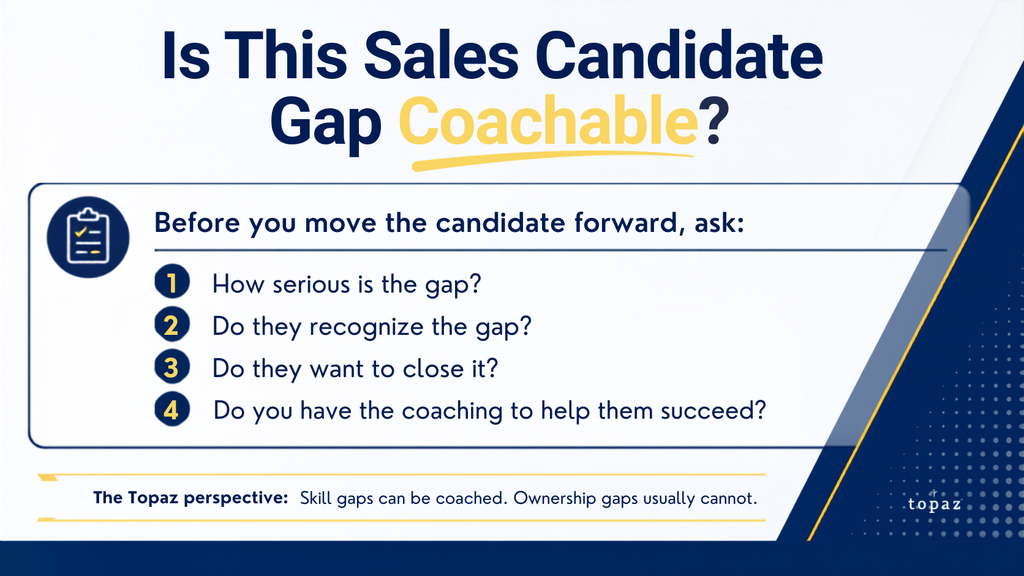
Four Questions to Ask Before Moving a Sales Candidate Forward
When you find a gap in a sales candidate, pause before making the decision.
These four questions can help you decide whether the candidate should continue in the hiring process.
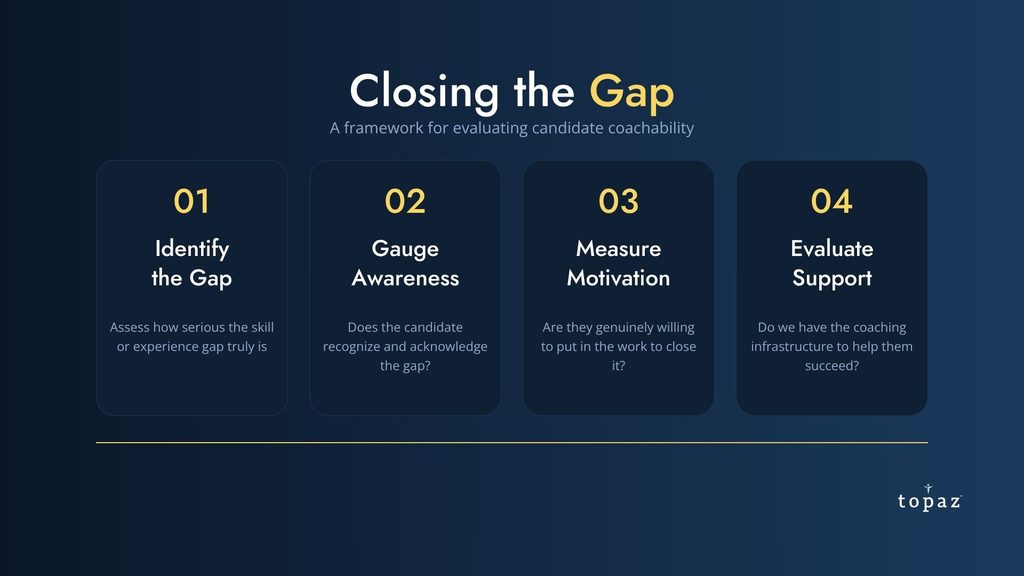
1. How Serious Is the Gap?
First, understand the size of the gap.
Is this a small skill gap that can be improved with coaching, or is it a major mismatch for the role?
For example, “limited prospecting experience” can mean several different things. It may mean the candidate has done some prospecting but needs more structure. It may mean they have opened new business through referrals and relationships but have not done much cold outreach. Or it may mean they have avoided prospecting entirely.
Those are very different situations.
2. Does the Candidate Recognize the Gap?
A candidate cannot improve a gap they do not acknowledge.
If the role requires new business development and the candidate has limited prospecting experience, they need to understand why that matters. They do not have to be perfect, but they do need to be honest.
A strong candidate may say, “I understand that this role requires more prospecting than I have done in the past. I would need coaching and structure, but I am willing to build that skill.”
That kind of answer shows awareness.
A weaker candidate may dismiss the issue, avoid the question, or act like the gap does not matter.
That is a warning sign.
In sales, self-awareness matters because improvement usually starts with ownership.
3. Do They Want to Close the Gap?
Awareness is not enough.
The candidate also has to want to improve.
Many people say they are coachable in an interview. The real question is whether they have shown a pattern of learning, adapting, and doing the work required to get better.
This is especially important in sales because improvement is not always comfortable. It may require role practice, feedback, repetition, rejection, and accountability.
If a candidate has a gap but is motivated, humble, and willing to learn, there may be a path forward.
A sales candidate with skill gaps can still be a strong hire. A candidate who lacks ownership or willingness to improve is much harder to develop.
4. Do You Have the Training and Coaching to Help Them Succeed?
This is the part many companies overlook.
Even if the candidate is aware of the gap and wants to improve, the company needs to ask a hard question:
Can we actually help this person close the gap?
If they need better discovery skills, do you have a sales process and coaching rhythm?
If they need to ramp up quickly, do you have onboarding that teaches the behaviors required for the role?
A candidate cannot close an important gap with motivation alone. They need training, coaching, practice, feedback, and a manager who knows how to support their development.
This is where Topaz Sales Consulting helps companies make better sales hiring decisions. The issue is not only whether the candidate has potential. The issue is whether the company has the process, coaching, and structure to turn that potential into performance.
How to Decide Whether the Gap Is a Deal Breaker
Once you understand the gap, the decision becomes clearer.
If the candidate recognizes the gap, wants to improve, shows coachability, and your company has the training or onboarding to support them, the gap may be something you can close.
But if the candidate does not acknowledge the gap, does not want to do the work, resists coaching, or is missing a skill that is central to the role, moving forward becomes much riskier.
This is where many companies make expensive hiring mistakes. They either talk themselves into a candidate because they like them, or they walk away from someone who may have been trainable with the right support.
The goal is not to find a perfect candidate. The goal is to make a clear decision based on what the role requires, what the candidate can do today, and whether the gap can realistically be closed.
Topaz Sales Consulting helps companies make those decisions with a stronger sales hiring process, better candidate evaluation, and the right coaching structure after the hire.
A Better Sales Hiring Process Reduces the Guesswork
Sales hiring should not come down to gut feeling.
A structured sales hiring process helps your company define what the role really requires, evaluate the candidate against those requirements, and decide whether any gaps are manageable or too risky.
That matters because many hiring mistakes happen when leaders make emotional decisions. They may like a candidate’s confidence, personality, or industry background and overlook a serious gap. Or they may reject someone too quickly without understanding whether the gap could be closed with the right coaching and onboarding.
A better process gives your team a clearer way to evaluate the candidate before the hire is made.
Topaz Sales Consulting helps companies strengthen that process, uncover real sales ability during interviews, identify candidate gaps, and make better decisions about who should move forward.
Need Help Hiring Better Salespeople?
Not every sales candidate gap should end the conversation.
But every gap should be understood before the hire is made.
Topaz Sales Consulting helps companies improve their sales hiring process, evaluate sales candidates more effectively, and build the systems needed to hire, onboard, coach, and develop stronger salespeople.
If your company is trying to avoid costly sales hiring mistakes, improve candidate evaluation, or decide whether a sales candidate’s skill gap can realistically be closed, Topaz can help you build a better process.
Request a consultation with Topaz Sales Consulting to discuss how your team can hire stronger salespeople and make better sales hiring decisions.