Most salespeople believe they need to educate their prospects.
They are not completely wrong.
In many sales conversations, buyers do want (and need) to learn something. They may need to understand the problem more clearly, compare different options, or see why one solution may be better than another.
Education has a place in the sales process.
The problem is timing.
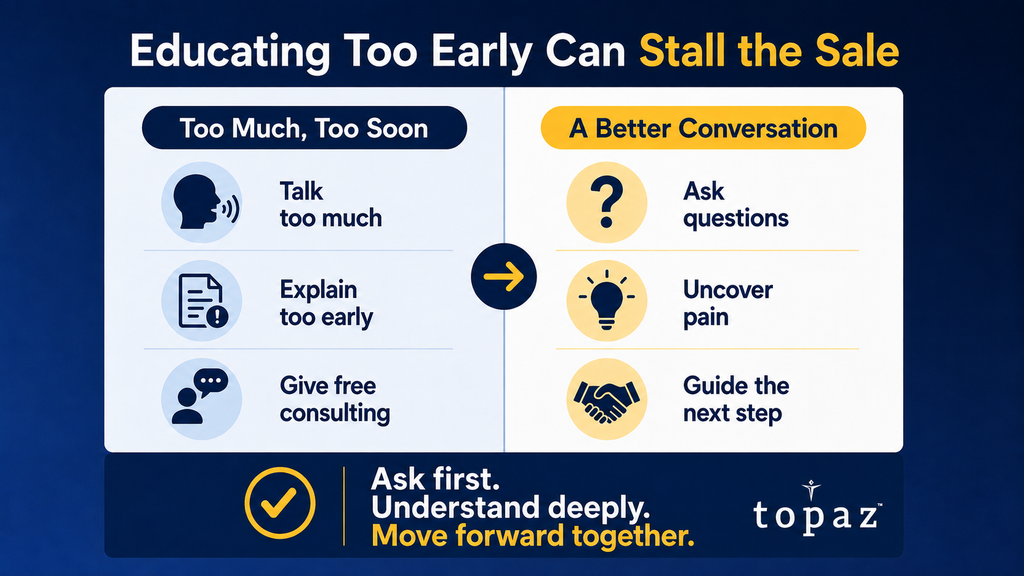
Many salespeople educate too early. They answer questions before they understand why the buyer is asking. They explain solutions before they fully understand the problem. They provide information the buyer did not ask for. They try to prove their expertise before they have earned the right to make a recommendation.
It usually comes from a good place. The salesperson wants to be helpful. They want to show they know what they are talking about. They want the buyer to feel informed.
But too much education too early can create a bigger problem.
The salesperson starts talking more than listening. The buyer receives information, but the salesperson learns very little. The conversation may sound productive, but the deal does not move forward, and the only result may have been “free consulting”.
If your sales team has first or second meetings that feel positive but do not turn into real opportunities, this may be one of the reasons.
When Salespeople Talk Too Much, They Learn Too Little
When salespeople talk too much, they lose the opportunity to learn.
They may not learn what problem the buyer is actually trying to solve. They may not learn why the issue matters now. They may not learn who else is involved in the decision. They may not learn what the buyer has already tried, what did not work, or what happens if nothing changes.
That information matters.
Without it, the salesperson may provide answers that sound helpful but do not create movement.
The buyer may appreciate the information and still do nothing. They may take the free advice and keep shopping. They may bring the information to another vendor. Or they may leave the conversation feeling like they heard a lot about the salesperson’s company, but not enough about their own problem.
That is where many sales conversations fall short.
The buyer does not need another person giving them a long explanation. They need a Buyer Facilitator who can help them uncover or think more clearly about the issue they are trying to solve.
Better Sales Discovery Starts With Curiosity
A strong sales discovery process does not start with a presentation.
It starts with curiosity.
Not fake curiosity. Not scripted curiosity. Real curiosity.
The kind of curiosity that makes the buyer stop and think.
Strong sales discovery questions help the buyer better understand their own situation. They also show the buyer that the salesperson is not just trying to pitch something. They are trying to understand what is really happening.
That is where trust starts.
A salesperson who rushes into education may sound like every other salesperson. A salesperson who asks thoughtful questions can stand out.
The best sales questions do more than collect information. They help the buyer see the problem differently. They uncover urgency. They reveal cost, risk, frustration, impact, and motivation. They help the salesperson understand whether there is a real opportunity. And how does the salesperson know they asked the best question? When the buyer says, “That’s a good question, I didn’t think of that.”
That is the part many salespeople miss.
They think expertise means having all the answers. In many cases, expertise is shown through the quality of the questions.
Why Buyers Do Not Always Want More Information
Many buyers already have access to more information than they need.
They can search online. They can read articles. They can compare companies. They can watch videos. They can ask several vendors the same questions.
In fact, Gartner research found that 75% of B2B buyers prefer a sales experience without direct interaction with a sales representative, reinforcing how comfortable buyers have become gathering information independently.
So when they agree to a sales conversation, they may not only be looking for more information.
They may be looking for someone who can help them make sense of their situation.
This is where educating too early can hurt the salesperson.
If the salesperson spends too much time explaining, the buyer may not feel understood. The conversation becomes one-sided. The buyer hears about the company, the product, the service, or the process, but does not get enough help thinking through their own issue.
That is when deals stall.
The buyer may not say, “You talked too much.” They may simply stop responding. They may ask for time to think about it. They may say they need to review internally. They may move on to another company.
The salesperson may think the buyer was not serious.
But sometimes the issue is that the salesperson gave information without creating enough value in the conversation.
The Cost of Educating Prospects Too Early
Educating prospects too early can create several problems.
It can waste time because the salesperson may spend the conversation explaining things that are not connected to the buyer’s real issue.
It can reduce urgency because the buyer may not fully understand the cost of the problem yet.
It can turn the salesperson into free consulting because the buyer gets ideas, advice, and information without giving clarity, commitment, or a next step.
It can also make the salesperson sound like every other vendor.
That is a problem because buyers usually do not move forward just because they were educated.
They move forward when they believe the problem matters, the timing matters, and the salesperson understands enough to guide them toward the right next step.
Topaz President Jorge Chavez explores this distinction in the short video, Do I Need to Educate the Buyer?
When Should Salespeople Educate Prospects?
Salespeople should educate prospects after they understand the buyer’s situation well enough to make the education useful.
That does not mean withholding information. It means not rushing.
There is a difference between answering a question and over-explaining. There is a difference between giving useful context and turning the conversation into a presentation. There is a difference between being helpful and giving away too much too early.
Before educating the buyer, the salesperson should understand the problem, the reason it matters, the impact of doing nothing, and what the buyer is trying to accomplish.
That expectation is not minor. Salesforce research found that 73% of customers expect companies to understand their unique needs and expectations.
Once the salesperson understands those things, education becomes more valuable.
Instead of explaining everything, they can explain what matters.
That is a better sales conversation.
Signs Your Salespeople May Be Educating Too Early
Take a look at your team’s recent sales conversations. Do any of these patterns sound familiar?
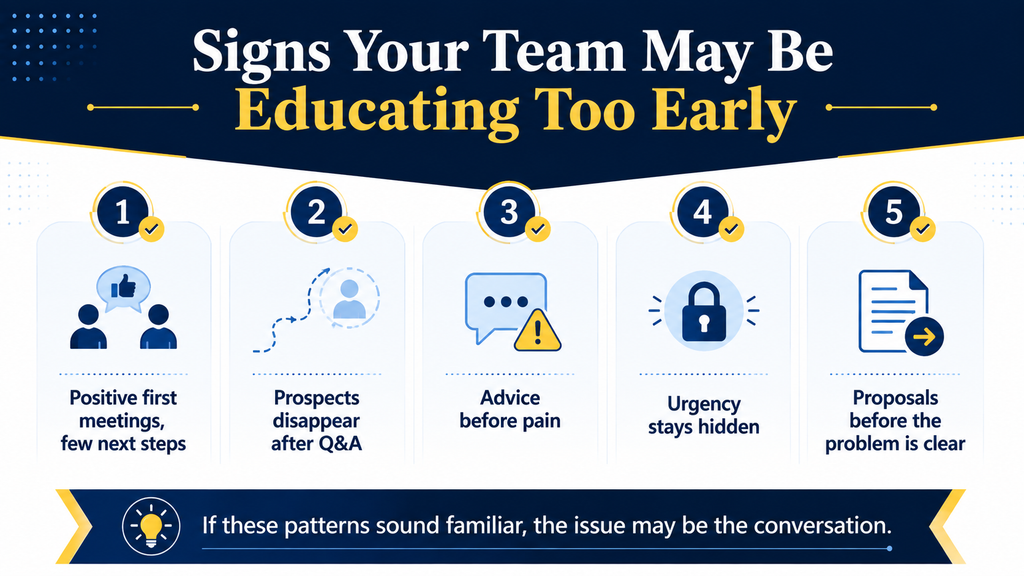
Your sales team may be educating prospects too early if you notice these patterns:
First meetings feel positive, but few move to a real next step.
Salespeople spend most of the call explaining the company, product, service, or process.
Prospects ask a few questions, receive answers, and then disappear.
Salespeople give advice before understanding the buyer’s pain.
The team struggles to uncover urgency.
Proposals are sent before the buyer’s problem is fully clear.
Salespeople believe the buyer “just needed more information.”
Buyers say they need to think about it, but never re-engage.
These are often signs that the sales conversation is too education-heavy and not discovery-focused enough.
How Topaz Helps Sales Teams Improve Sales Conversations
Improving sales conversations does not mean your salespeople should stop educating buyers.
It means they need to learn when to educate, when to ask, when to listen, and when to guide the conversation forward.
That is not always easy to fix with a simple script or a few better questions. Many salespeople have built the habit of answering too quickly, explaining too much, or trying to prove expertise by talking more.
Topaz Sales Consulting helps sales teams recognize those patterns and replace them with a stronger sales discovery process.
The goal is not to make salespeople robotic. The goal is to help them have better business conversations. Conversations where the buyer feels understood, the salesperson uncovers the real issue, and the next step is based on value instead of information overload.
Through practical sales training and coaching, Topaz helps salespeople ask better questions, uncover real buyer pain, avoid premature pitching, and create more useful conversations with prospects.
Need Help Improving Your Sales Discovery Process?
If your sales team is struggling to get past first or second meetings, the issue may not be effort.
It may be the conversation.
Your salespeople may be educating too early, answering too quickly, or giving away too much information before they fully understand the buyer’s problem.
Topaz Sales Consulting helps companies improve sales conversations, strengthen discovery skills, and build a more effective sales process.
If your salespeople are talking too much, educating too early, or struggling with stalled deals, Topaz can help your team stop repeating those mistakes and create better buyer conversations.
Request a consultation with Topaz Sales Consulting to discuss how your team can improve the sales discovery process and close stronger opportunities.