Most sales leadership problems don’t start when someone gets promoted. They start when someone gets hired. They start when we hire people based on how they present themselves rather than on how they help prospects and clients solve their problems.
We’ve seen companies pour time and money into fixing sales managers. New coaching frameworks. Better dashboards. More defined processes.
None of it sticks if the hiring decision rewards speed, confidence, and persuasion over a win/win outcome through buyer facilitation. Those traits you initially hired for don’t just affect internal performance. They shape how buyers experience your company.
Sales is still one of the few positions where hiring is based on how someone presents themselves rather than on how they help another human think through a decision. That’s why hiring for sales must be different than hiring for any other role in the company.
Why traditional hiring breaks sales teams
Most organizations hire salespeople the same way they hire everyone else. They scan resumes. Interview for culture fit. Ask about past wins. Trust their instincts. That approach works when the role is execution. Sales is not execution. Sales is guiding decisions when information is incomplete.
When hiring focuses on personality and confidence instead of how someone manages a buying conversation, companies unintentionally select for:
• Fast talkers instead of careful listeners
• Confidence instead of curiosity
• Control instead of collaboration
• Pressure instead of clarity
Those traits can produce early wins. They also create downstream problems.
These are the reps who struggle to slow conversations down, resist coaching, and default to instinct when things get uncomfortable. When promoted, they become managers who oversee activity rather than develop how others think within buyer conversations.
The leadership gap shows up months or years later. The hiring gap caused it. Metahire exists to interrupt this pattern before it becomes culture.
Metahire starts with a different assumption
Metahire is built on a simple belief.
If sales exists to help buyers make sound decisions and determine mutual fit, then sales hiring must evaluate how a candidate thinks while a decision is forming.
- Not how polished they are.
- Not how aggressive they sound.
- Not how well they sell themselves in an interview.
Metahire evaluates whether someone can operate as a Buyer Facilitator when a clear understanding of the issue is missing and pressure is present. Not based on gut feel, but through observable behavior inside live conversations.
That changes everything about how sales hiring works.
How sales hiring needs to be different
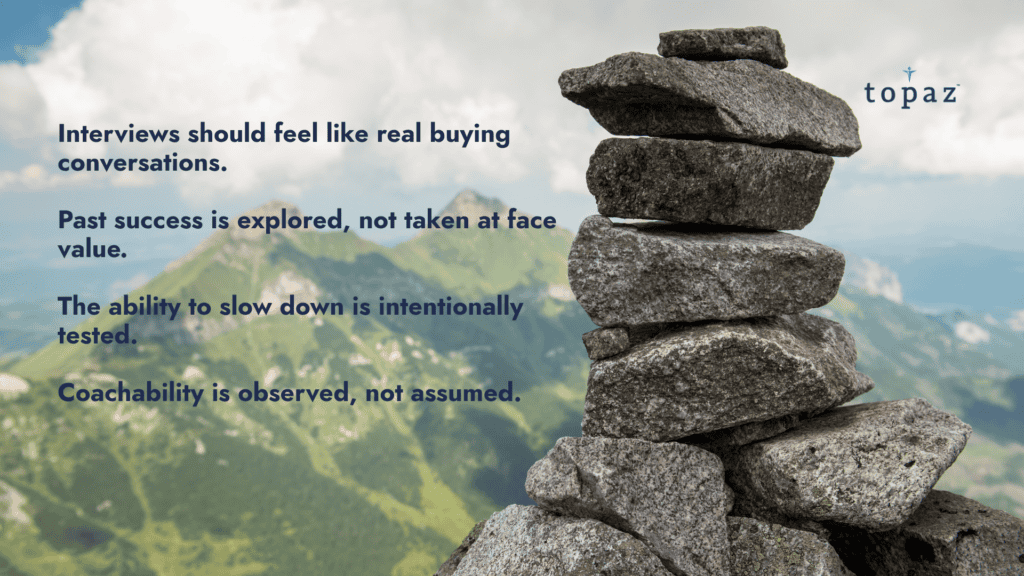
1. Interviews should feel like real buying conversations
In Metahire, candidates aren’t asked to perform. They’re placed into conversations where the path forward isn’t obvious, and clarity must be created collaboratively. You’re not listening for the right answer.
You’re listening for:
• Do they ask questions that help the situation become clearer?
• Do they slow the conversation when assumptions appear?
• Do they explore uncertainty or rush to resolution?
• Do they invite interactive conversations or drive toward an outcome?
This allows you to see how candidates engage in conversations, surface assumptions, and create clarity.
2. Past success is explored, not taken at face value
Metahire treats past results as context, not proof.
Instead of asking, “What was your quota?” we explore:
• How buyers arrived at decisions
• Where deals stalled and what created clarity
• What assumptions were uncovered late
• How the rep adjusted once new information emerged
This shows whether success came from repeatable facilitation or favorable conditions.
Numbers matter. Understanding how those numbers happened matters more. Because repeatability, not heroics, is what scales revenue.
3. The ability to slow down is intentionally tested
Strong buyer facilitators don’t rush certainty. They create space for thinking. Slowing down is how trust is built when decisions matter.
Metahire looks for candidates who:
• Are comfortable with pauses
• Ask follow-up questions instead of defending positions
• Resist filling silence with persuasion
• Can say, “I don’t have enough clarity yet.”
These are the reps who can guide buyers through complicated decisions and later coach others to do the same.
4. Coachability is observed, not assumed
Most organizations discover resistance to coaching after onboarding.
Metahire surfaces it during hiring.
Candidates receive live feedback and are observed for:
• Openness versus defensiveness
• Curiosity versus explanation
• Ability to adjust in the moment
If someone cannot adapt their thinking in an interview, they won’t adapt it in the field.
Hiring shapes your future sales leaders
Here’s the part most companies overlook. Every sales hire is a future leadership decision. Whether you intend to promote them or not, their behavior will be copied.
If you hire reps who rely on urgency and control, you will eventually promote managers who coach the same way. If you hire reps who slow conversations down and help buyers think clearly, leadership development becomes reinforcement and growth.
Metahire isn’t about finding perfect salespeople. It’s about selecting coachable, accountable people whose selling behavior shows how you want buyers to experience your company.
Revenue machines are built upstream
Companies talk about building revenue-generating machines. Machines depend on consistency. Consistency comes from clear thinking. Clear thinking is created when salespeople are trained and hired to facilitate, not persuade. That chain starts with hiring.
When sales hiring changes:
- Onboarding accelerates
- Coaching becomes developmental
- Promotion decisions feel obvious
- Forecasts stabilize
- Buyers feel respected
- Buyers feel confident in their decisions, even when the answer is no
Sales stops being about personalities and becomes a discipline.
Before your next sales hire
Ask yourself, are we hiring someone who can slow down a buying conversation and later coach others to do the same? Are they someone who helps a buyer make a clear decision, or someone who knows how to push for a yes?
The answer determines not just your next quarter, but the kind of sales leaders your organization will grow.
A Sales Hiring Self-Audit
Before you make your next sales hire, pause here. We created a downloadable PDF version of this audit so you can walk through these questions with your leadership team, hiring manager, or anyone involved in the sales interview process.
Download the Sales Hiring Self-Audit and use it before your next round of interviews, not after the hire starts, creating questions you wish you had asked sooner.
Answer these without defending your current process. The value is in noticing what you’ve been assuming.
1. What do we actually hire for when we say “good salesperson”?
Confidence? Energy? Likeability? Past wins?
Or the ability to ask thoughtful questions and sit with uncertainty?
If your answer leans heavily toward personality traits, you may be hiring performers, not buyer facilitators.
2. Does our sales hiring process feel more like job interviews or buying conversations?
Are candidates mostly talking about themselves?
Or are they expected to explore, clarify, and adapt in real time?
Sales hiring should resemble selling. If it doesn’t, you’re guessing.
3. How often do we confuse past results with repeatable behavior?
Do we examine how deals were won?
Or do we assume success means skill?
Past numbers without behavioral context create false confidence.
4. Do we screen how candidates think, or just what they say?
When answers are incomplete or messy, do they slow down and explore?
Or do they rush to sound certain?
Many sales calls happen with some ambiguity. Hiring should too.
5. How do candidates respond when they don’t know the answer?
Do they ask follow-up, clarifying questions?
Do they acknowledge uncertainty?
Or do they fill space and sell their way through it?
Comfort with not knowing is a prerequisite for facilitating good decisions.
6. Do we evaluate coachability before day one?
Are candidates given live feedback during interviews?
And do we observe whether they integrate it or resist it?
If someone can’t be coached while trying to get the job, they won’t be coached once they have it.
7. Are we hiring people we’d trust to slow a buyer down?
When pressure shows up, do candidates default to pushing forward?
Or can they pause, reframe, and create clarity?
Revenue becomes predictable when reps know when not to advance.
8. Does our hiring criteria align with how we say we sell?
If your sales philosophy embraces curiosity, getting to the truth, and mutual fit,
does your hiring process actively select for those behaviors?
Misalignment here creates constant friction later.
9. If this hire became a manager, would they develop thinking or manage activity?
Would they coach conversations or review dashboards?
Would they model curiosity or provide answers?
Every sales hire is a future leadership decision, whether you intend it or not.
Want to use this with your team?
Download the Sales Hiring Self-Audit and bring it to your next hiring conversation. Have each person answer the questions independently, then compare where your process is clear, where it relies on instinct, and where you may be confusing interview presence with true sales capability.
A good sales hire should be able to do more than impress you in an interview. They should be able to think, listen, clarify, and help a buyer reach a confident decision. Your hiring process should reveal that before the offer letter goes out.