
Sales leaders can easily fall into autopilot after team training. While processes, language, and tools may be in place, issues often persist. Hires who seemed promising may not be a true fit. Managers may spend time reteaching basics that should already be mastered. The pipeline may lack structure and predictability. In these cases, the root cause is often management, not the sales team.
Sales management training is essential because managers set the standard for sales execution. They establish coaching routines, reinforce processes, and define accountability. Well-trained managers enable consistent performance across diverse personalities without making the team overly scripted. This clarity leads to stronger coaching, a healthier pipeline, and improved results. Sustainable growth follows disciplined leadership, not wishful thinking.
Leaders often hesitate to invest in management training, assuming strong salespeople will naturally excel as managers or that experience alone is sufficient. In practice, managing salespeople requires distinct skills: coaching, judgment, structure, and guiding without micromanaging. Sales management training addresses these needs. Even with solid rep training, persistent issues like poor hires, basic coaching, and disorganized pipelines indicate a need for focused management development.
Below are the top five reasons to invest in sales consulting services, with a focus on sales management training.
Reason 1: Sales Management Training Establishes a Repeatable Hiring System
A key benefit of sales management training is the development of a reliable hiring system. Sales teams improve when managers identify mutual fit, assess relevant strengths, and make informed hiring decisions. Relying on instinct or industry familiarity often leads to costly mismatches. These gaps result in slow onboarding, weak pipeline activity, and managers spending excessive time addressing poor hires.
Sales management training enables leaders to clearly define the behaviors required for success. Rather than relying on vague terms like “good communicator” or “people person,” managers learn to identify specific qualities. For example, can the candidate remain curious under pressure, ask thoughtful questions, handle pushback professionally, and follow processes while maintaining authenticity? These criteria support better hiring decisions.
With this clarity, the hiring process improves at every stage. Recruiting becomes targeted, screening is more effective, and interviews yield deeper insights. Managers learn to ask behavior-based questions that reveal how candidates think, prepare, listen, and solve problems. This approach goes beyond surface-level impressions and helps identify true fit for consultative sales roles.
Better hiring directly affects the pipeline. When you bring in people who fit the role, they ramp faster and require less rescue. Managers can spend their time coaching. Effective hiring directly impacts the pipeline. Employees who fit the role ramp up quickly and require less intervention. Managers can focus on coaching strategy, opportunity quality, and decision-making instead of correcting avoidable errors. A well-qualified team ensures a cleaner funnel and purposeful progress. Consistency begins with strong hiring practices.

*This is a sample breakdown of attribute distribution. Yours might look different than this!
Tools Your Managers Can Develop for Stronger Sales Hiring
Effective sales management training equips managers with useful tools they can use well beyond the workshop. These may include scorecards aligned with your ideal customer and sales process, interview questions designed to assess judgment and coachability, panel interviews to evaluate preparation and presence, and role-plays to observe how candidates handle real sales conversations.
- Interview scorecards
- Targeted questions
- Panel interviews
- Role practice simulations
Even though specific tools may differ by company, the core principle remains the same. When managers understand what to assess and how to evaluate it, hiring becomes more consistent and less reactive.
Reason 2: Trained Managers Coach Behaviors, Not Purely Numbers
Effective sales managers do not rely solely on metrics. They recognize that results stem from consistent behaviors. While revenue, conversion rates, and pipeline movement are important, these metrics only reflect past performance. Trained managers focus on the underlying actions that drive results, which leads to major change.
Sales management training helps managers build a consistent and practical coaching routine. Rather than waiting for poor results to prompt difficult discussions, managers learn to hold regular one-on-ones focused on performance drivers. Effective coaching sessions address opportunity quality, skill development, recent interactions, and areas where a representative may be struggling in the sales process.
Many managers intervene only after a deal is lost, missing the optimal coaching window. Trained managers observe patterns early. They recognize weak discovery before it leads to unclear proposals, spot inadequate follow-up before buyers disengage, and notice when a representative advances opportunities missing real commitment, which can inflate pipelines and distort forecasts.
This is the true value of sales management training: it teaches managers to coach the behaviors that drive results. Managers learn to observe calls, ask targeted questions, and guide representatives toward specific improvements instead of offering general advice such as “build more urgency” or “ask better questions.” For example, effective coaching might include, “You moved to a solution too quickly and never uncovered the impact of the problem,” or, “You left the call with interest but not a definite next step.” This approach gives actionable feedback for improvement.
When managers effectively coach behaviors, improved results typically follow.
Reason 3: Sales Management Training Helps Your CRM Reflect Reality
A common mistake among sales leaders is treating the CRM as an exact reflection of reality. In truth, it records what the team reports, which may not always match actual progress. A well-organized dashboard can still conceal weak discovery, unclear next steps, and opportunities that do not belong in the forecast. Many sales managers have experienced this: a deal is marked as active, the notes appear sufficient, and there is a general sense of progress. However, by the end of the quarter, much of the pipeline fails to materialize.
Sales management training enables managers to align processes with actual field activity. It teaches them to use the CRM for clarity, not as a repository for assumptions. This begins by properly defining each pipeline stage. If one representative advances an opportunity based on perceived interest, while another does so only after a confirmed decision-making step, forecasting becomes unreliable. Trained managers form well-defined exit criteria for each stage, ensuring CRM updates present genuine buyer progress rather than optimism.
This discipline improves the quality of pipeline reviews. Rather than asking, “What do you think will close?” managers can pose more targeted questions: What problem has the buyer acknowledged? What commitment has been made? What is the agreed next step? Who is involved in the decision? These questions ground the discussion in facts and help managers coach representatives to distinguish between activity and genuine progress.
Effective sales management training also fosters better collaboration between managers and operations, moving beyond the perception of operations as merely enforcing compliance. Sales operations and front-line managers should work together, combining data information with field observations. When these groups are aligned, systems improve, fields become more relevant, redundant inputs are eliminated, and the CRM more accurately reflects the sales process. As a result, forecasting becomes more reliable, and terms such as ‘commit’ and ‘best case’ are consistently understood across the team.
These improvements do not occur simply by purchasing a CRM license. They require structure, ongoing reinforcement, and managers committed to verifying actual progress. Practically, this means teams need clear, shared definitions for each buyer stage, specified next steps before advancing opportunities, and regular pipeline reviews focused on verification. When managers are trained to lead in this way, the CRM becomes a valuable decision-support tool rather than a repository for unqualified deals.

Reason 4: Sales Management Training Strengthens Culture, Retention, and Onboarding
Sales culture typically declines gradually. Standards become unclear, coaching loses consistency, and pressure is distributed unevenly. As a result, top performers become frustrated while new representatives struggle to understand expectations. This issue commonly stems from management rather than the team itself. When managers lack proper training, the culture becomes reactive, leading to uncertainty and inconsistency across the team.
Effective sales management training restores structure. Managers learn to communicate clear expectations, provide consistent coaching, and promote ongoing performance development. This firmness improves retention, as strong representatives typically leave due to a disorderly or unsupportive environment, inconsistent coaching, or perceived unfairness, as opposed to isolated setbacks.
Trained managers have a significant impact by conducting effective one-on-one meetings. Productive coaching sessions help representatives clarify their thinking, develop specific skills, and understand their next steps. When coaching is consistent and fair, team members are more receptive to feedback and trust its purpose, building a culture of growth rather than apprehension.
Training equips managers to set measurable and attainable expectations. Missing clear definitions of success, representatives may create their own standards, leading to inconsistency. Effective managers clarify key behaviors, milestones, and outcomes, and reinforce them in a way the team can follow.
This clarity is especially important during onboarding. New hires perform better when managers link early behaviors to defined milestones. A structured 30-60-90 day plan guides new employees through learning processes, applying knowledge with support, and building consistent habits. Without this structure, new hires may receive excessive information, insufficient guidance, and unclear priorities.
Reason 5: Sales Management Training Helps Managers Coach Through Objections
Frustrated sales teams frequently cite persistent objections such as price, timing, competition, and skepticism. Those challenges can demotivate representatives, especially if objections are perceived as rejection rather than valuable information. Effective sales management is essential to help managers coach their teams to address objections constructively.
Sales management training helps managers turn objections into coaching moments instead of fire drills. When a rep gets rattled, many managers jump straight to tactics. Sales management training enables managers to use objections as coaching opportunities rather than reactive situations. Instead of immediately offering tactics, trained managers assess the underlying issue by asking targeted questions. Understanding whether the objection is due to timing, clarity, or value enables more individualized coaching, including what proof they requested, what concerns were raised, and what commitments were made. In that kind of conversation, managers can help reps stop circling objections and start getting curious about them. Instead of reaching for a discount or trying to push through resistance, reps learn to ask sharper questions, understand the underlying concern, and guide the buyer toward a more honest next step.
Over time, this approach changes how teams handle resistance. Lost deals become learning opportunities, and stalled opportunities prompt analysis of where conversations lost momentum. Representatives begin to view objections as valuable signals, leading to greater confidence, discipline, and fewer last-minute concessions. Managers play a key part in fostering clear, effective conversations.
A 30-Day Starting Plan for Sales Management Success
Sales management training is most effective when managers develop relevant skills at the right time. While each team’s needs may vary, a straightforward 30-day plan provides a solid starting point:
Week 1: Establish the foundation for hiring. Develop a role scorecard to define success in the position, and create an interview bank to help managers consistently assess key behaviors before advancing candidates.
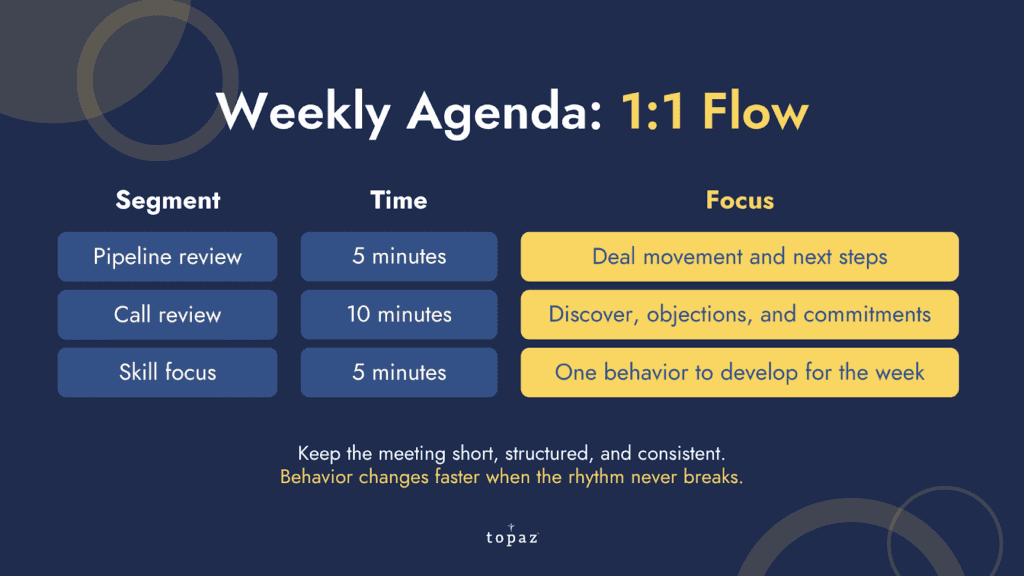
Week 2: Implement weekly one-on-one meetings. Each session should include pipeline review, call feedback, and a specific development focus. Encourage two-way feedback to ensure the conversation is productive and accountability is mutual.
Week 3: Align managers and Revenue Operations on pipeline stages and required next steps. Ensure the CRM accurately reflects buyer progress rather than speculations or hopeful projections.
Week 4: Conduct a focused coaching initiative on discovery and objection handling. Assign each representative a specific behavior to improve, and review progress weekly to ensure measurable development.
Train the Managers, and the Team Gets Better
While the sales team manages the conversations, managers establish the tone, standards, and pace. Well-trained managers improve hiring, ensure consistent coaching, and create a pipeline that accurately reflects actual progress.
This is why sales management training is essential. It enables leaders to hire more effectively, coach with clarity, and guide teams proactively. Training additionally strengthens accountability, forecasting, and daily development, making it easier for high-performing representatives to succeed.
A practical first step is to evaluate how managers hire, coach, assess the pipeline, and conduct one-on-ones. Focus on improving one area at a time, as incremental management improvements often produce significant team gains.
When managers need further support, effective sales management training helps them develop into leaders whom the team is motivated to follow, rather than simply focusing on deals and reports.
FAQs
How is training in sales management different from sales training?
Sales training sharpens what reps do day-to-day. Management training shapes how leaders hire, coach, and build the systems that make selling easier.
And without that layer, even your best reps will hit the same walls again and again.
How long does it take to see results?
Give it a few months. Once managers start hiring with structure and coaching with consistency, you’ll notice cleaner forecasts and a steadier team rhythm.
It’s not overnight, but results will happen when your people stay with the process.
What makes a good training program worth it?
Go for something practical. The best programs teach managers to run better interviews, one-on-ones, and deal reviews.
What matters is whether it changes how your team works the following Monday.
Citations
Chavez, C. (2025, June 12). How To Manage a Sales Team When Everyone Sells Differently. Topaz Sales Consulting. https://www.topazsalesconsulting.com/how-to-manage-a-sales-team/
Chavez, J. (2018, June 15). Metahire Sales Hiring System. Topaz Sales Consulting. https://www.topazsalesconsulting.com/hiring/